Everything you need to know about maintaining your spare tire - from checking pressure to understanding when it's safe to use. This guide pulls together information scattered across your manual into one place.
(Reference: Owner's Manual, pg. 532, 594, 620)
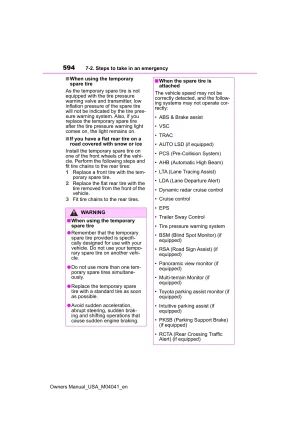
Remember that the temporary spare tire provided is specifically designed for use with your vehicle. Do not use your temporary spare tire on another vehicle.
Do not use more than one temporary spare tires simultaneously.
Replace the temporary spare tire with a standard tire as soon as possible.
Avoid sudden acceleration, abrupt steering, sudden braking and shifting operations that cause sudden engine braking.
Source: Owner's Manual pages 594
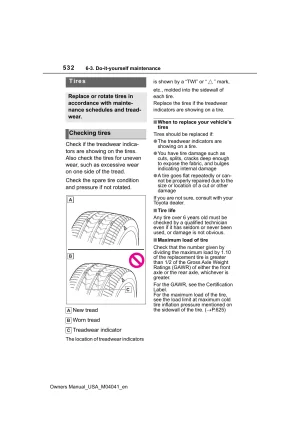
Tires are one of the most critical safety components of your vehicle. Regular inspections and timely replacement keep you safe on the road. Replace tires when any of the following conditions are present:
Treadwear Indicators Showing
The treadwear indicators are showing on a tire. These are small raised sections molded into the sidewall of each tire and marked with "TWI" or a similar symbol. When the tire tread wears down to the level of these indicators, replacement is mandatory.
Visible Damage
You have tire damage such as:
Repair Limitations
A tire goes flat repeatedly or cannot be properly repaired due to the size or location of a cut or other damage. Even minor damage can sometimes lead to repeated air loss if the damage is in a location that prevents effective repair.
Age-Based Replacement (Critical)
Any tire over 6 years old must be checked by a qualified technician even if it has seldom or never been used, or damage is not obvious. Tire rubber degrades over time regardless of use, and this age-based policy is essential for safety.
Tire Load Capacity Verification
Replacement tires must meet or exceed your vehicle's load requirements. Check that the number given by dividing the maximum load by 1.10 of the replacement tire is greater than 1/2 of the Gross Axle Weight Ratings (GAWR) of either the front axle or the rear axle, whichever is greater. You can find the GAWR on the Certification Label inside the driver's door jamb, and the tire's maximum load rating on the sidewall.
When in doubt about replacement criteria, your Toyota dealer can help.
Source: Owner's Manual page 532
Your Tacoma comes with a temporary spare rather than a full-size spare. It's designed specifically for your truck and differs from standard tires in a few important ways:
The temporary spare tire is not equipped with the tire pressure warning valve and transmitter. This creates two important limitations:
Source: Owner's Manual page 594
When you have a flat tire and need to install the temporary spare:
If you have a flat rear tire on a road covered with snow or ice, follow this modified procedure to maintain traction and stability:
This procedure maintains better traction at the rear wheels while using the temporary spare at the front.
Source: Owner's Manual page 594
When the temporary spare tire is installed and the vehicle is driven, the following systems may not operate correctly due to the difference in tire diameter and the lack of TPMS monitoring:
Safety Systems Affected:
Convenience Features Affected:
Visibility/Navigation Systems Affected:
Because of these limitations, avoid sudden acceleration, abrupt steering, sudden braking, and shifting operations that cause sudden engine braking.
Source: Owner's Manual page 594
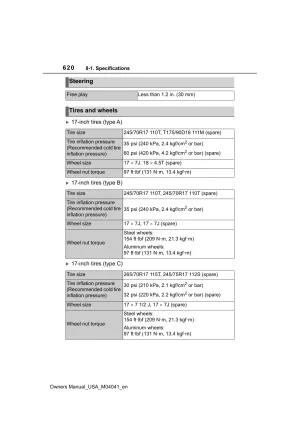
Your vehicle may be equipped with one of three tire and wheel configurations. Use these specifications to verify you have the correct tire pressure and wheel nut torque for your specific vehicle:
Configuration Type A (17-inch Standard Tires)
Configuration Type B (17-inch Standard Match)
Configuration Type C (17-inch Larger Alternative)
Note: All tire inflation pressures are recommended cold pressure values. Check tire pressure when the vehicle has been parked for at least 3 hours or when the vehicle has been driven less than 1 mile at moderate speed.
Source: Owner's Manual page 620
Check spare tire pressure seasonally alongside regular tire maintenance. Temperature swings affect tire pressure, so seasonal checks ensure your spare is ready when you need it. Many owners overlook this because the spare sits unused in the trunk.
Pro Tip: Establish a routine to check spare tire pressure each spring and fall during time changes. This takes five minutes and ensures your emergency backup is reliable.
Source: Community guidance - tacomaexplorer.com
A simple way to check tire tread depth on both standard and spare tires is the penny test. Insert an upside-down penny into the tread grooves. If you can see the top of Lincoln's head, the tire has reached approximately 2/32 inch — the legal minimum tread depth — and must be replaced immediately.
Source: Community guidance - tacomaexplorer.com
Your temporary spare tire is stored underneath the truck bed where it is exposed to water, salt, dirt, and temperature extremes. The underside of the truck is a harsh environment. Neglecting this storage location allows corrosion and accelerates tire degradation.
Occasionally check the spare tire storage area for water accumulation and debris. Ensure the spare is properly secured and hasn't shifted during rough driving.
Source: Community guidance - tacomaexplorer.com
The 4th Gen Tacoma's under-bed spare tire storage has less clearance than previous generations, particularly on TRD Off-Road and other models with factory equipment. If you plan to upgrade to a full-size spare or modify the tire setup, verify clearance with suspension components and the trailer hitch before purchase.
Many owners have discovered the hard way that aftermarket larger spare tires don't fit due to the trailer hitch and sway bar consuming space under the bed.
Source: Community guidance - tacoma4g.com forums
When deploying a spare in an emergency, follow this sequence carefully:
Following the right sequence helps you change a tire safely and confidently at the roadside.
Source: Community guidance - tacomaexplorer.com
The temporary spare tire requires significantly higher inflation pressure (60 psi or 32 psi depending on configuration) compared to standard tires (30-35 psi). This higher pressure is necessary because the smaller temporary spare wheel cannot support the vehicle's weight at standard tire pressures. The higher pressure compensates for the smaller wheel diameter and the altered weight distribution.
Always verify the correct pressure for your specific configuration on your door jamb sticker. Incorrect pressure on a temporary spare is a safety hazard.
Source: OEM specifications + community confirmation
The 6-year replacement rule for tires older than that applies to all tires, including spare tires. If your temporary spare has been installed for 6 years, even if it hasn't been driven on, it should be checked by a qualified technician. Rubber degrades due to UV exposure, ozone, temperature cycling, and oxidation regardless of vehicle use.
Source: Owner's Manual page 532
Although the manual says "replace the temporary spare tire with a standard tire as soon as possible," manufacturers recommend following the industry-standard 50-70 mile maximum limit for emergency use. Some owners do use a temporary spare for extended periods beyond this guideline. If you exceed the standard distance, understand that system safety features are compromised, fuel economy may decrease due to altered tire diameter and increased rolling resistance, and handling characteristics change. Extended use beyond the recommended 50-70 mile limit may stress suspension components designed for the lighter load of a temporary spare.
Source: Industry standards + Toyota Owner's Manual guidance
Regular Inspections (Every 6 months):
Annual Inspection:
When Replacing Tires:
Owner's Manual Pages:
Additional Sources:
Disclaimer:
This guide is derived from the official 2024+ Toyota Tacoma Owner's Manual (OM04041U) with supplementary information from the owner community and authoritative sources. Always follow your official owner's manual for warranty compliance. This is a reference guide only. Consult your Toyota dealer if you have questions about spare tire maintenance, tire replacement criteria, or system limitations.
(Reference: Owner's Manual, pg. 532, 594, 620)
Spare Tire Safety, Temporary Spare Maintenance, Pressure Requirements, Replacement Procedures
Remember that the temporary spare tire provided is specifically designed for use with your vehicle. Do not use your temporary spare tire on another vehicle.
Do not use more than one temporary spare tires simultaneously.
Replace the temporary spare tire with a standard tire as soon as possible.
Avoid sudden acceleration, abrupt steering, sudden braking and shifting operations that cause sudden engine braking.
Source: Owner's Manual pages 594
Understanding Tire Maintenance and Replacement
When to Replace Your Vehicle's Tires
Tires are one of the most critical safety components of your vehicle. Regular inspections and timely replacement keep you safe on the road. Replace tires when any of the following conditions are present:
Treadwear Indicators Showing
The treadwear indicators are showing on a tire. These are small raised sections molded into the sidewall of each tire and marked with "TWI" or a similar symbol. When the tire tread wears down to the level of these indicators, replacement is mandatory.
Visible Damage
You have tire damage such as:
- Cuts or splits in the sidewall or tread
- Cracks deep enough to expose the fabric
- Bulges indicating internal damage
Repair Limitations
A tire goes flat repeatedly or cannot be properly repaired due to the size or location of a cut or other damage. Even minor damage can sometimes lead to repeated air loss if the damage is in a location that prevents effective repair.
Age-Based Replacement (Critical)
Any tire over 6 years old must be checked by a qualified technician even if it has seldom or never been used, or damage is not obvious. Tire rubber degrades over time regardless of use, and this age-based policy is essential for safety.
Tire Load Capacity Verification
Replacement tires must meet or exceed your vehicle's load requirements. Check that the number given by dividing the maximum load by 1.10 of the replacement tire is greater than 1/2 of the Gross Axle Weight Ratings (GAWR) of either the front axle or the rear axle, whichever is greater. You can find the GAWR on the Certification Label inside the driver's door jamb, and the tire's maximum load rating on the sidewall.
When in doubt about replacement criteria, your Toyota dealer can help.
Source: Owner's Manual page 532
Temporary Spare Tire System
What is a Temporary Spare Tire?
Your Tacoma comes with a temporary spare rather than a full-size spare. It's designed specifically for your truck and differs from standard tires in a few important ways:
- Size: T175/90D18 or 245/70R17 (depending on configuration)
- Inflation Pressure: 60 psi (420 kPa) or 32 psi (220 kPa) cold pressure (significantly higher than standard tires)
- Wheel Size: 18 × 4.5T, 17 × 7J (dedicated spare wheel)
- Duration: Temporary use only - designed as a get-you-home solution
IMPORTANT: Tire Pressure Monitoring System (TPMS) Incompatibility
The temporary spare tire is not equipped with the tire pressure warning valve and transmitter. This creates two important limitations:
- Low Pressure Not Detected: Low inflation pressure of the spare tire will not be indicated by the tire pressure warning system.
- Warning Light Persistence: If you replace the temporary spare tire after the tire pressure warning light comes on, the light will remain on until the system is reset or the standard tire is reinstalled.
Source: Owner's Manual page 594
Using the Temporary Spare Tire
Standard Procedure
When you have a flat tire and need to install the temporary spare:
- Safely move your vehicle away from traffic
- Engage the parking brake
- Remove the temporary spare tire and wheel from the trunk
- Use the jack to lift the vehicle (follow the jack positioning in your owner's manual)
- Remove the wheel lugs using the wrench
- Remove the flat tire
- Install the temporary spare tire on the hub
- Hand-tighten the wheel lugs, then lower the vehicle
- Torque the wheel lugs to specification (see Specifications section below)
Special Procedure: Flat Rear Tire on Snow or Ice
If you have a flat rear tire on a road covered with snow or ice, follow this modified procedure to maintain traction and stability:
- Install the temporary spare tire on one of the front wheels of the vehicle (do not install on the rear)
- Remove the undamaged tire from the front and install it on the rear where the flat tire was located
- Fit tire chains to the rear tires for traction in the snow/ice conditions
This procedure maintains better traction at the rear wheels while using the temporary spare at the front.
Source: Owner's Manual page 594
System Limitations When Spare Tire is Installed
When the temporary spare tire is installed and the vehicle is driven, the following systems may not operate correctly due to the difference in tire diameter and the lack of TPMS monitoring:
Safety Systems Affected:
- ABS (Anti-lock Braking System) & Brake Assist
- VSC (Vehicle Stability Control)
- TRAC (Traction Control)
- AUTO LSD (Automatic Limited-Slip Differential) if equipped
- PCS (Pre-Collision System)
- AHB (Automatic High Beam) if equipped
- LTA (Lane Tracing Assist)
- LDA (Lane Departure Alert)
- Trailer Sway Control if equipped
- PKSB (Parking Support Brake) if equipped
Convenience Features Affected:
- Dynamic Radar Cruise Control
- Cruise Control
- EPS (Electronic Power Steering)
- Tire Pressure Warning System
- BSM (Blind Spot Monitor) if equipped
- RSA (Road Sign Assist) if equipped
- RCTA (Rear Crossing Traffic Alert) if equipped
Visibility/Navigation Systems Affected:
- Panoramic View Monitor if equipped
- Multi-terrain Monitor if equipped
- Toyota Parking Assist Monitor if equipped
- Intuitive Parking Assist if equipped
Because of these limitations, avoid sudden acceleration, abrupt steering, sudden braking, and shifting operations that cause sudden engine braking.
Source: Owner's Manual page 594
Technical Specifications
Tire and Wheel Configurations
Your vehicle may be equipped with one of three tire and wheel configurations. Use these specifications to verify you have the correct tire pressure and wheel nut torque for your specific vehicle:
Configuration Type A (17-inch Standard Tires)
| Specification | Standard Tire | Spare Tire |
|---|---|---|
| Tire Size | 245/70R17 110T | T175/90D18 111M |
| Tire Inflation Pressure | 35 psi (240 kPa, 2.4 kgf/cm²) | 60 psi (420 kPa, 4.2 kgf/cm²) |
| Wheel Size | 17 × 7J | 18 × 4.5T |
| Wheel Nut Torque | 97 ft·lbf (131 N·m, 13.4 kgf·m) | 97 ft·lbf (131 N·m, 13.4 kgf·m) |
Configuration Type B (17-inch Standard Match)
| Specification | Standard Tire | Spare Tire |
|---|---|---|
| Tire Size | 245/70R17 110T | 245/70R17 110T |
| Tire Inflation Pressure | 35 psi (240 kPa, 2.4 kgf/cm²) | 35 psi (240 kPa, 2.4 kgf/cm²) |
| Wheel Size | 17 × 7J | 17 × 7J |
| Wheel Nut Torque (Steel) | 154 ft·lbf (209 N·m, 21.3 kgf·m) | 154 ft·lbf (209 N·m, 21.3 kgf·m) |
| Wheel Nut Torque (Aluminum) | 97 ft·lbf (131 N·m, 13.4 kgf·m) | 97 ft·lbf (131 N·m, 13.4 kgf·m) |
Configuration Type C (17-inch Larger Alternative)
| Specification | Standard Tire | Spare Tire |
|---|---|---|
| Tire Size | 265/70R17 115T | 245/75R17 112S |
| Tire Inflation Pressure | 30 psi (210 kPa, 2.1 kgf/cm²) | 32 psi (220 kPa, 2.2 kgf/cm²) |
| Wheel Size | 17 × 7½J | 17 × 7J |
| Wheel Nut Torque (Steel) | 154 ft·lbf (209 N·m, 21.3 kgf·m) | 154 ft·lbf (209 N·m, 21.3 kgf·m) |
| Wheel Nut Torque (Aluminum) | 97 ft·lbf (131 N·m, 13.4 kgf·m) | 97 ft·lbf (131 N·m, 13.4 kgf·m) |
Note: All tire inflation pressures are recommended cold pressure values. Check tire pressure when the vehicle has been parked for at least 3 hours or when the vehicle has been driven less than 1 mile at moderate speed.
Source: Owner's Manual page 620
Real-World Tips & Context
Seasonal Maintenance
Check spare tire pressure seasonally alongside regular tire maintenance. Temperature swings affect tire pressure, so seasonal checks ensure your spare is ready when you need it. Many owners overlook this because the spare sits unused in the trunk.
Pro Tip: Establish a routine to check spare tire pressure each spring and fall during time changes. This takes five minutes and ensures your emergency backup is reliable.
Source: Community guidance - tacomaexplorer.com
Using the Penny Test for Treadwear Monitoring
A simple way to check tire tread depth on both standard and spare tires is the penny test. Insert an upside-down penny into the tread grooves. If you can see the top of Lincoln's head, the tire has reached approximately 2/32 inch — the legal minimum tread depth — and must be replaced immediately.
Source: Community guidance - tacomaexplorer.com
Important Consideration: Under-Bed Storage Maintenance
Your temporary spare tire is stored underneath the truck bed where it is exposed to water, salt, dirt, and temperature extremes. The underside of the truck is a harsh environment. Neglecting this storage location allows corrosion and accelerates tire degradation.
Occasionally check the spare tire storage area for water accumulation and debris. Ensure the spare is properly secured and hasn't shifted during rough driving.
Source: Community guidance - tacomaexplorer.com
4th Gen Tacoma-Specific Space Constraints
The 4th Gen Tacoma's under-bed spare tire storage has less clearance than previous generations, particularly on TRD Off-Road and other models with factory equipment. If you plan to upgrade to a full-size spare or modify the tire setup, verify clearance with suspension components and the trailer hitch before purchase.
Many owners have discovered the hard way that aftermarket larger spare tires don't fit due to the trailer hitch and sway bar consuming space under the bed.
Source: Community guidance - tacoma4g.com forums
Emergency Safety Procedures
When deploying a spare in an emergency, follow this sequence carefully:
- Pull to a safe location away from traffic
- Activate hazard lights
- Engage parking brake
- Use wheel chocks to prevent rolling
- Loosen lug nuts BEFORE jacking (much easier)
- Jack the vehicle carefully using the proper jack point
- Remove lug nuts completely
- Remove flat tire
- Install spare tire
- Tighten lugs in a star pattern to avoid warping
- Lower vehicle completely
- Final torque to specification (see Specifications section)
Following the right sequence helps you change a tire safely and confidently at the roadside.
Source: Community guidance - tacomaexplorer.com
Understanding Pressure Requirements
The temporary spare tire requires significantly higher inflation pressure (60 psi or 32 psi depending on configuration) compared to standard tires (30-35 psi). This higher pressure is necessary because the smaller temporary spare wheel cannot support the vehicle's weight at standard tire pressures. The higher pressure compensates for the smaller wheel diameter and the altered weight distribution.
Always verify the correct pressure for your specific configuration on your door jamb sticker. Incorrect pressure on a temporary spare is a safety hazard.
Source: OEM specifications + community confirmation
Tire Age and Storage Considerations
The 6-year replacement rule for tires older than that applies to all tires, including spare tires. If your temporary spare has been installed for 6 years, even if it hasn't been driven on, it should be checked by a qualified technician. Rubber degrades due to UV exposure, ozone, temperature cycling, and oxidation regardless of vehicle use.
Source: Owner's Manual page 532
Real-World Extended Spare Use
Although the manual says "replace the temporary spare tire with a standard tire as soon as possible," manufacturers recommend following the industry-standard 50-70 mile maximum limit for emergency use. Some owners do use a temporary spare for extended periods beyond this guideline. If you exceed the standard distance, understand that system safety features are compromised, fuel economy may decrease due to altered tire diameter and increased rolling resistance, and handling characteristics change. Extended use beyond the recommended 50-70 mile limit may stress suspension components designed for the lighter load of a temporary spare.
Source: Industry standards + Toyota Owner's Manual guidance
Spare Tire Maintenance Checklist
Regular Inspections (Every 6 months):
- Check spare tire inflation pressure against specification for your configuration
- Visually inspect for cracks, cuts, or damage
- Verify the temporary spare wheel lugs are tight
- Confirm the spare is properly stored in the trunk and hasn't shifted
Annual Inspection:
- Full treadwear assessment on temporary spare (penny test)
- Check for signs of aging or UV damage on sidewalls
- Verify the jack and lug wrench are accessible and functional
- Inspect under-bed storage area for water accumulation or corrosion
When Replacing Tires:
- Replace or service the temporary spare at the same time as main tires
- Reset tire pressure monitoring system if disconnected during service
- Have new spare installed with correct pressure for your configuration
Source Attribution
Owner's Manual Pages:
- Tire replacement criteria: Page 532
- Temporary spare tire procedures and system limitations: Page 594
- Tire specifications and wheel nut torque: Page 620
Additional Sources:
- tacomaexplorer.com
- tacoma4g.com
- Community forums and owner experiences
Disclaimer:
This guide is derived from the official 2024+ Toyota Tacoma Owner's Manual (OM04041U) with supplementary information from the owner community and authoritative sources. Always follow your official owner's manual for warranty compliance. This is a reference guide only. Consult your Toyota dealer if you have questions about spare tire maintenance, tire replacement criteria, or system limitations.
Attachments
Last edited by a moderator: