Keeping your tires properly inflated affects safety, ride comfort, tire life, and fuel economy. Here's everything you need to know about checking and adjusting tire pressure on your 4th Gen Tacoma, from the official procedure to real-world tips from the owner community.
(Reference: Owner's Manual, pg. 545-546, 620)
WARNING - Proper inflation is critical to save tire performance
Keep your tires properly inflated. If the tires are not properly inflated, the following conditions may occur which could lead to an accident resulting in death or serious injury:
Source: Owner's Manual Page 546
Tire pressure is one of those simple things that makes a big difference. Your Tacoma has TPMS, but that electronic system backs up manual checks. It doesn't replace them.
The TPMS warning light illuminates when tire pressure drops about 25% below specification. At 35 psi specification, this means the warning triggers around 26 psi, a point where tire wear and handling are already compromised. Regular manual checks catch gradual pressure loss before it becomes a safety concern.
Check your tire pressure every two weeks, or at least once a month. Do not forget to check the spare.
Source: Owner's Manual Page 546
Check only when the tires are cold. If your Tacoma has been parked for at least 3 hours or has not been driven for more than 1 mile or 1.5 km, you will get an accurate cold tire inflation pressure reading.
Source: Owner's Manual Page 546
Tip: Morning checks before your first drive of the day provide the most accurate cold readings. Tire pressure increases about 1 psi for every 10 degrees Fahrenheit of temperature rise.
Source: Owner's Manual Page 546
Checking and Adjusting Tire Pressure (Page 546):
Source: Owner's Manual Page 546
Pro Tips:
Your 4th Gen Tacoma may be equipped with one of three tire configurations. Identify your type from the tire and loading information label on the driver's door jamb.
17-inch Tires (Type A):
Source: Owner's Manual Page 620
17-inch Tires (Type B):
Source: Owner's Manual Page 620
17-inch Tires (Type C):
Source: Owner's Manual Page 620
Important Note: Type A and B require 35 psi, while Type C requires only 30 psi. Type C has wider 265/70R17 tires with a higher load rating (115T vs 110T), which allows for lower operating pressure. Using the wrong pressure for your tire configuration can affect handling, wear, and fuel economy. Always verify your tire type against the tire and loading information label.
Driving with incorrect tire inflation pressure may result in the following:
If a tire needs frequent inflating, have it checked by your Toyota dealer.
Source: Owner's Manual Page 546
Tire Specification Quick Reference Chart:

Figure 1: 4th Gen Tacoma Tire Configurations - Quick Reference (Data from Page 620)
Tire Pressure Check Procedure:

Figure 2: Tire Pressure Check Procedure (Steps from Page 546)
When to Check - Decision Guide:

Figure 3: When to Check Tire Pressure - Is Now a Good Time? (Criteria from Pages 545-546)
The following insights come from the 4th Gen Tacoma owner community and can help you avoid common pitfalls.
Many 4th Gen Tacomas are delivered with tires at 45+ psi. Tacomas are secured to transport trucks with straps around tire perimeters, requiring overinflation during shipping. Dealers often overlook adjusting this during pre-delivery inspection.
Reducing from 45 psi shipping pressure to your specified pressure (30-35 psi depending on type) dramatically improves ride quality. Multiple owners reported the ride becoming "much smoother and more pleasant" after correcting from delivery overinflation. This is especially noticeable on rougher roads.
Source: Tacoma4G.com
Keep a quality digital gauge in the vehicle. Gas station gauges are often inaccurate. A dedicated gauge ensures consistent readings over time. Forum members recommend purchasing a reliable gauge and trusting cold tire measurements from that over other sources.
Source: Tacoma4G.com
The 4th Gen Tacoma allows you to set custom TPMS warning thresholds. Some trucks have the TPMS warning threshold set to 35 psi or even 40 psi from the factory, despite the door placard recommending 30 psi on Type C configurations. This causes nuisance low-pressure warnings in cold weather.
Set the threshold to match your running pressure to get accurate alerts. When off-roading with aired-down tires, some owners set the threshold to 20 psi to avoid constant warnings.
Source: Tacoma4G.com
Account for temperature changes: about 1 psi per 10 degrees Fahrenheit. Some owners run 1-2 psi higher than specification in fall/winter to avoid low-pressure warnings as temperatures drop. Conversely, tires inflated in cold weather may read higher when warmer.
Source: Tacoma4G.com
Source: Tacoma4G.com, Tacoma3G.com
Why check every 2 weeks if I have TPMS?
The TPMS warning light illuminates when tire pressure drops about 25% below specification. At 35 psi specification, this means the warning triggers around 26 psi, a point where tire wear and handling are already compromised. Regular manual checks catch gradual pressure loss before it becomes a safety concern.
What if my pressure is higher than specified after driving?
This is normal. Heat generated during driving causes air to expand. Do not release air to reach the cold specification. This would result in underinflation once the tires cool. Only adjust pressure when tires are cold.
Should I inflate to the pressure on the tire sidewall?
No. The sidewall pressure (often 44 psi or higher) is the maximum pressure the tire can safely hold, not the recommended operating pressure. Always use the vehicle's specified pressure from the tire and loading information label or the specifications tables above.
Do I need to check the spare?
Yes. The spare tire can lose pressure over time, and you will discover this at the worst possible moment, when you need it. The spare tire on Type A configurations requires 60 psi, which is significantly higher than the running tires. Check it monthly.
The complete tire pressure information can be found on the following pages of your owner's manual:
Owner's Manual Pages:
Additional Sources:
Disclaimer:
This guide is derived from the official 2024+ Toyota Tacoma Owner's Manual (OM04041U) with supplementary information from the owner community. Always follow your official owner's manual for warranty compliance. This is a reference guide only.


(Reference: Owner's Manual, pg. 545-546, 620)
CRITICAL SAFETY WARNING
WARNING - Proper inflation is critical to save tire performance
Keep your tires properly inflated. If the tires are not properly inflated, the following conditions may occur which could lead to an accident resulting in death or serious injury:
- Excessive wear
- Uneven wear
- Poor handling
- Possibility of blow outs resulting from overheated tires
- Air leaking from between tire and wheel
- Wheel deformation and/or tire damage
Source: Owner's Manual Page 546
Tire Pressure Check, PSI Specifications, TPMS Warning, Inflation Guide
Why Check Tire Pressure Manually?
Tire pressure is one of those simple things that makes a big difference. Your Tacoma has TPMS, but that electronic system backs up manual checks. It doesn't replace them.
The TPMS warning light illuminates when tire pressure drops about 25% below specification. At 35 psi specification, this means the warning triggers around 26 psi, a point where tire wear and handling are already compromised. Regular manual checks catch gradual pressure loss before it becomes a safety concern.
Check Interval
Check your tire pressure every two weeks, or at least once a month. Do not forget to check the spare.
Source: Owner's Manual Page 546
Cold Tire Requirement
Check only when the tires are cold. If your Tacoma has been parked for at least 3 hours or has not been driven for more than 1 mile or 1.5 km, you will get an accurate cold tire inflation pressure reading.
Source: Owner's Manual Page 546
Tip: Morning checks before your first drive of the day provide the most accurate cold readings. Tire pressure increases about 1 psi for every 10 degrees Fahrenheit of temperature rise.
Additional Instructions
- Always use a tire pressure gauge. It is difficult to judge if a tire is properly inflated based only on its appearance.
- It is normal for the tire inflation pressure to be higher after driving as heat is generated in the tire. Do not reduce tire inflation pressure after driving.
- Never exceed the vehicle capacity weight. Passengers and luggage weight should be placed so that the vehicle is balanced.
Source: Owner's Manual Page 546
Step-by-Step Procedure
Checking and Adjusting Tire Pressure (Page 546):
- Remove the tire valve cap.
- Press the tip of the tire pressure gauge onto the tire valve.
- Read the pressure using the gauge gradations.
- If the tire inflation pressure is not at the recommended level, adjust the pressure.
If you add too much air, press the center of the valve to deflate. - After completing the tire inflation pressure measurement and adjustment, apply soapy water to the valve and check for leakage.
- Put the tire valve cap back on.
Source: Owner's Manual Page 546
Pro Tips:
- When pressing the gauge onto the valve, you should hear a brief hiss as the gauge seats. If you hear continuous hissing, the gauge is not properly aligned.
- Take multiple readings to ensure accuracy. The first reading may release a small amount of air.
- The valve cap does not hold air pressure; its purpose is to keep dirt and moisture out of the valve stem. Always replace it.
- If a tire consistently loses pressure between checks, have the tire, valve, and wheel inspected by a professional.
Tire Specifications
Your 4th Gen Tacoma may be equipped with one of three tire configurations. Identify your type from the tire and loading information label on the driver's door jamb.
17-inch Tires (Type A):
| Specification | Value |
|---|---|
| Tire size | 245/70R17 110T |
| Spare tire size | T175/90D18 111M |
| Tire inflation pressure (cold) | 35 psi (240 kPa) |
| Spare tire inflation pressure | 60 psi (420 kPa) |
| Wheel size | 17 x 7J |
| Spare wheel size | 18 x 4.5T |
| Wheel nut torque | 97 ft-lbf (131 N-m) |
Source: Owner's Manual Page 620
17-inch Tires (Type B):
| Specification | Value |
|---|---|
| Tire size | 245/70R17 110T |
| Spare tire size | 245/70R17 110T (full-size) |
| Tire inflation pressure (cold) | 35 psi (240 kPa) |
| Spare tire inflation pressure | 35 psi (240 kPa) |
| Wheel size | 17 x 7J |
| Spare wheel size | 17 x 7J |
| Wheel nut torque (Steel wheels) | 154 ft-lbf (209 N-m) |
| Wheel nut torque (Aluminum wheels) | 97 ft-lbf (131 N-m) |
Source: Owner's Manual Page 620
17-inch Tires (Type C):
| Specification | Value |
|---|---|
| Tire size | 265/70R17 115T |
| Spare tire size | 245/75R17 112S |
| Tire inflation pressure (cold) | 30 psi (210 kPa) |
| Spare tire inflation pressure | 32 psi (220 kPa) |
| Wheel size | 17 x 7.5J |
| Spare wheel size | 17 x 7J |
| Wheel nut torque (Steel wheels) | 154 ft-lbf (209 N-m) |
| Wheel nut torque (Aluminum wheels) | 97 ft-lbf (131 N-m) |
Source: Owner's Manual Page 620
Important Note: Type A and B require 35 psi, while Type C requires only 30 psi. Type C has wider 265/70R17 tires with a higher load rating (115T vs 110T), which allows for lower operating pressure. Using the wrong pressure for your tire configuration can affect handling, wear, and fuel economy. Always verify your tire type against the tire and loading information label.
Effects of Incorrect Tire Inflation Pressure
Driving with incorrect tire inflation pressure may result in the following:
- Reduced fuel economy
- Reduced driving comfort and poor handling
- Reduced tire life due to wear
- Reduced safety
- Damage to the drive train
If a tire needs frequent inflating, have it checked by your Toyota dealer.
Source: Owner's Manual Page 546
Visual Reference
Tire Specification Quick Reference Chart:
Figure 1: 4th Gen Tacoma Tire Configurations - Quick Reference (Data from Page 620)
Tire Pressure Check Procedure:
Figure 2: Tire Pressure Check Procedure (Steps from Page 546)
When to Check - Decision Guide:
Figure 3: When to Check Tire Pressure - Is Now a Good Time? (Criteria from Pages 545-546)
Real-World Tips and Context
The following insights come from the 4th Gen Tacoma owner community and can help you avoid common pitfalls.
Check Tire Pressure Upon Delivery
Many 4th Gen Tacomas are delivered with tires at 45+ psi. Tacomas are secured to transport trucks with straps around tire perimeters, requiring overinflation during shipping. Dealers often overlook adjusting this during pre-delivery inspection.
Reducing from 45 psi shipping pressure to your specified pressure (30-35 psi depending on type) dramatically improves ride quality. Multiple owners reported the ride becoming "much smoother and more pleasant" after correcting from delivery overinflation. This is especially noticeable on rougher roads.
Source: Tacoma4G.com
Use Your Own Quality Gauge
Keep a quality digital gauge in the vehicle. Gas station gauges are often inaccurate. A dedicated gauge ensures consistent readings over time. Forum members recommend purchasing a reliable gauge and trusting cold tire measurements from that over other sources.
Source: Tacoma4G.com
TPMS Threshold Settings
The 4th Gen Tacoma allows you to set custom TPMS warning thresholds. Some trucks have the TPMS warning threshold set to 35 psi or even 40 psi from the factory, despite the door placard recommending 30 psi on Type C configurations. This causes nuisance low-pressure warnings in cold weather.
Set the threshold to match your running pressure to get accurate alerts. When off-roading with aired-down tires, some owners set the threshold to 20 psi to avoid constant warnings.
Source: Tacoma4G.com
Temperature Effects
Account for temperature changes: about 1 psi per 10 degrees Fahrenheit. Some owners run 1-2 psi higher than specification in fall/winter to avoid low-pressure warnings as temperatures drop. Conversely, tires inflated in cold weather may read higher when warmer.
Source: Tacoma4G.com
Common Mistakes to Avoid
- Trusting dealer pre-delivery tire pressure - Some dealers deliver trucks at shipping pressure (45+ psi), while others overinflate to prevent TPMS warnings. Always verify against your door jamb sticker before leaving the lot.
- Ignoring TPMS setting mismatch - Factory TPMS thresholds may not match your door placard pressure. False warnings lead to ignoring TPMS altogether.
- Forgetting to reset TPMS after adjusting pressure - After inflating to proper specification, the TPMS may need to be reinitialized to recognize the new baseline. See Page 538 for TPMS initialization procedures.
Source: Tacoma4G.com, Tacoma3G.com
Common Questions
Why check every 2 weeks if I have TPMS?
The TPMS warning light illuminates when tire pressure drops about 25% below specification. At 35 psi specification, this means the warning triggers around 26 psi, a point where tire wear and handling are already compromised. Regular manual checks catch gradual pressure loss before it becomes a safety concern.
What if my pressure is higher than specified after driving?
This is normal. Heat generated during driving causes air to expand. Do not release air to reach the cold specification. This would result in underinflation once the tires cool. Only adjust pressure when tires are cold.
Should I inflate to the pressure on the tire sidewall?
No. The sidewall pressure (often 44 psi or higher) is the maximum pressure the tire can safely hold, not the recommended operating pressure. Always use the vehicle's specified pressure from the tire and loading information label or the specifications tables above.
Do I need to check the spare?
Yes. The spare tire can lose pressure over time, and you will discover this at the worst possible moment, when you need it. The spare tire on Type A configurations requires 60 psi, which is significantly higher than the running tires. Check it monthly.
Recommended Products
- Digital tire pressure gauge
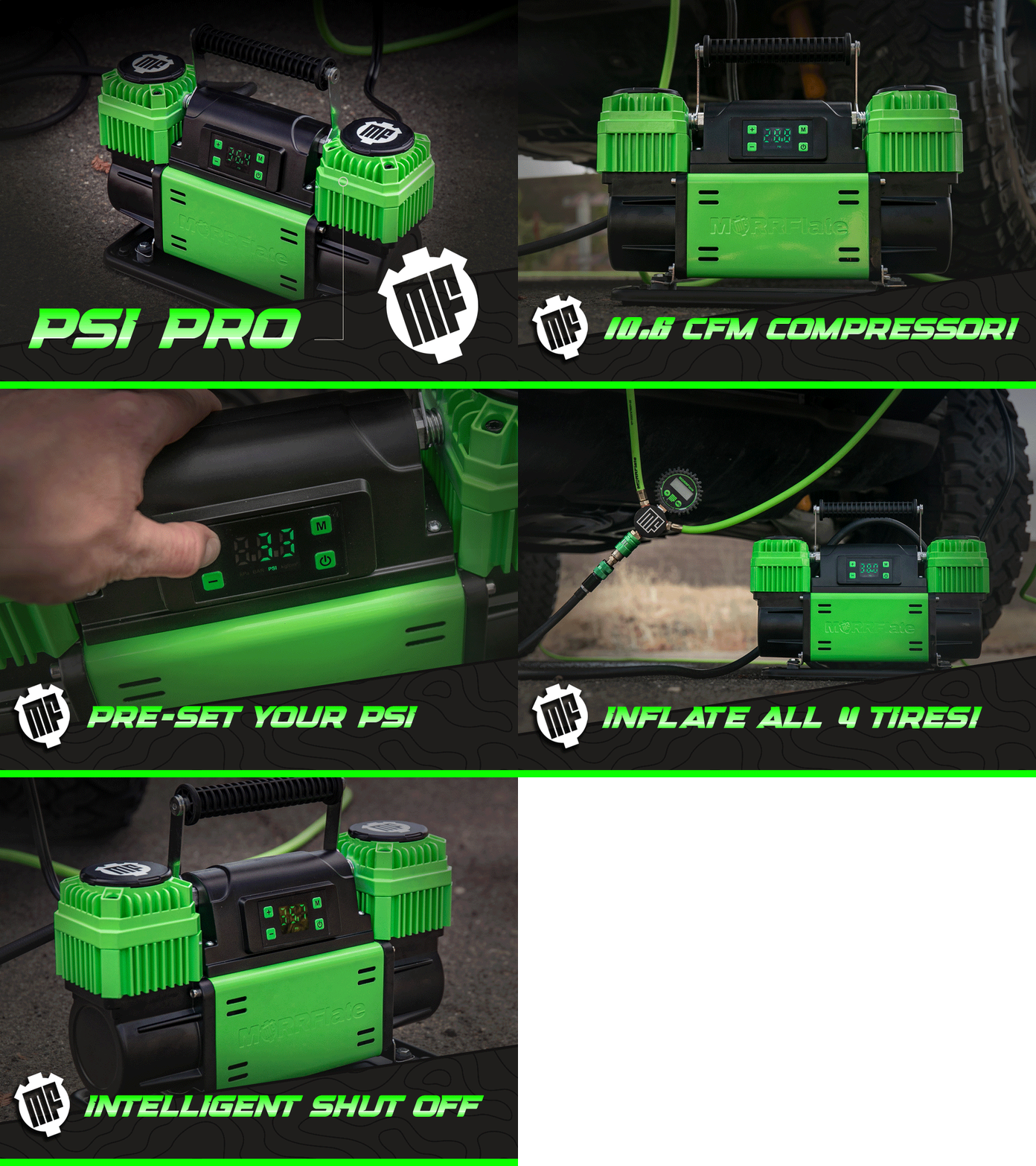
- Portable tire inflator / air compressor
- Soapy water spray bottle (for leak testing)
Manual Pages Reference
The complete tire pressure information can be found on the following pages of your owner's manual:
- Pages 545-546: Tire pressure checking procedure, check interval, cold tire requirements, safety warnings
- Page 620: Complete tire specifications by configuration (Type A, B, C)
- Page 538: TPMS initialization procedures (referenced)
Source Attribution
Owner's Manual Pages:
- Primary procedure: Pages 545-546
- Specifications: Page 620
- Safety precautions: Page 546
- TPMS initialization reference: Page 538
Additional Sources:
- Tacoma4G.com
- Tacoma3G.com
- 4GTaco.com
Disclaimer:
This guide is derived from the official 2024+ Toyota Tacoma Owner's Manual (OM04041U) with supplementary information from the owner community. Always follow your official owner's manual for warranty compliance. This is a reference guide only.
Last edited by a moderator: